
Summary
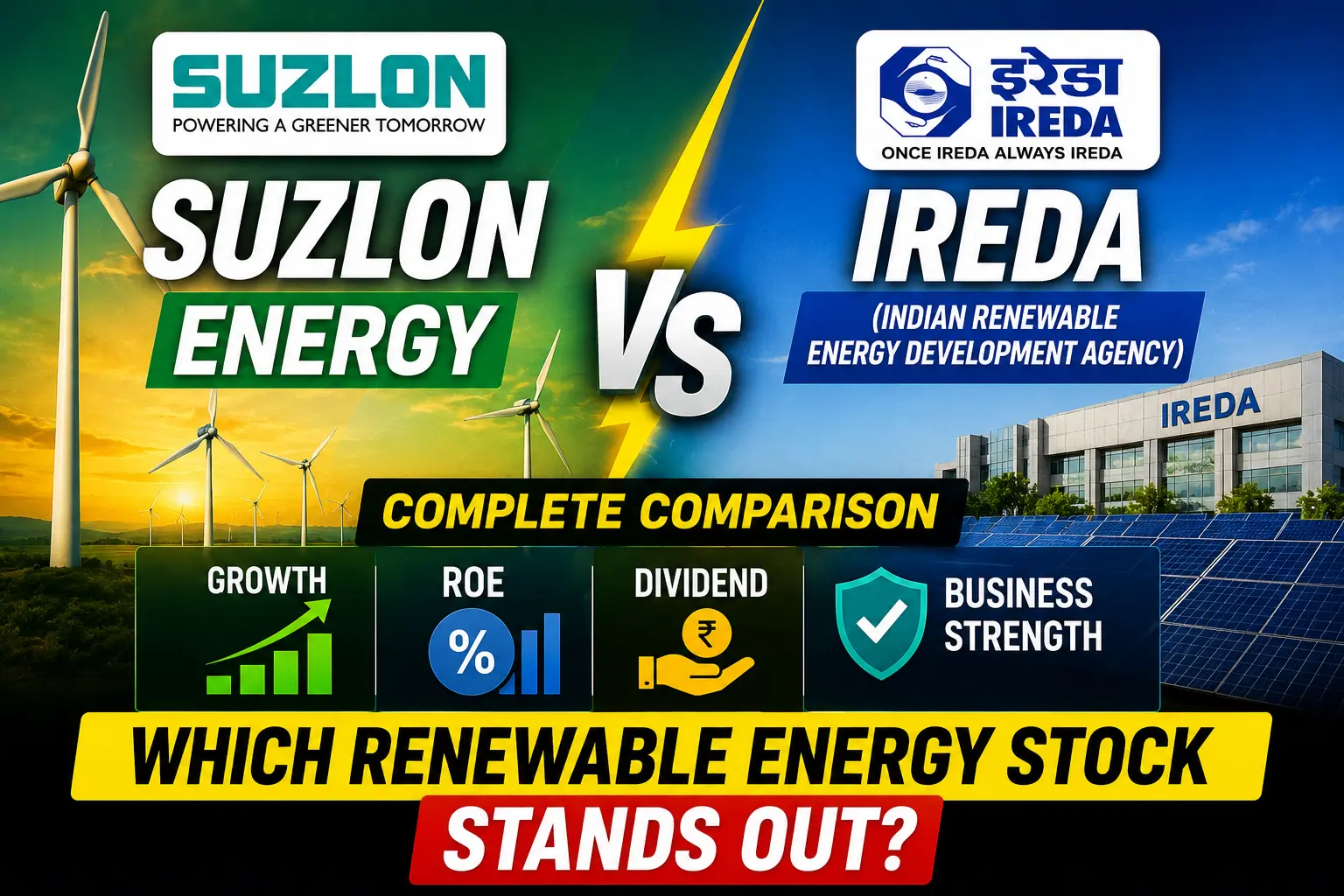
Renewable energy stocks continue to attract investor interest as governments worldwide accelerate clean energy investments and energy security becomes a bigger priority. Among the names frequently discussed in the sector are Suzlon Energy and Indian Renewable Energy Development Agency (IREDA), but the two companies operate very different businesses.
While Suzlon Energy is a wind energy equipment manufacturer, IREDA is a government-backed renewable energy financier. Here’s a detailed comparison of both companies across business model, financial strength, valuation metrics, dividends and growth prospects.
Renewable Energy Theme Continues to Drive Investor Interest
Renewable energy has become one of India’s fastest-growing investment themes as the country pushes toward its clean energy targets.
Rising investments in solar, wind, green hydrogen and power infrastructure have also brought renewable-focused companies back into the spotlight.
Suzlon Energy and IREDA have both delivered strong market returns over the years, but their businesses, risks and growth drivers are completely different.
Understanding those differences is important before comparing the two companies.
Why Investors Compare Suzlon Energy and IREDA
Although both companies are linked to renewable energy, they generate revenue in different ways.
Suzlon Energy earns revenue by manufacturing wind turbines, executing wind projects and providing long-term operation and maintenance services.
IREDA, on the other hand, is a government-owned non-banking financial company (NBFC) that finances renewable energy projects across solar, wind, hydro, biomass and emerging clean energy segments.
One company manufactures renewable energy equipment, while the other provides financing to the industry.
Key Comparison at a Glance
| Particulars | Suzlon Energy | IREDA |
|---|---|---|
| Sector | Wind Energy Equipment | Renewable Energy Finance |
| Business Model | Manufacturing & Services | Government-backed NBFC |
| Market Capitalisation | ₹73,843 Crore | ₹38,697 Crore |
| Return on Equity (ROE) | 79.58% | 20.16% |
| Latest Dividend | Re 1 (2008) | ₹0.60 per Share (2026) |
| Ownership | Private Company | Navratna PSU |
Business Model: Manufacturing vs Financing
Suzlon Energy’s business depends largely on India’s wind power installation cycle.
The company manufactures wind turbines, develops wind farms and provides operation and maintenance services after project commissioning. Strong order inflows and higher wind capacity additions generally support its earnings growth.
IREDA follows a completely different approach.
Instead of manufacturing equipment, it provides loans to renewable energy developers. The company earns interest income from financing solar parks, wind farms, transmission projects and other clean energy infrastructure.
As renewable investments increase, demand for project financing also grows, directly benefiting IREDA.
Financial Strength Comparison
Return on Equity (ROE) is one of the key indicators investors use to evaluate how efficiently a company generates profits from shareholders’ capital.
Suzlon Energy currently reports an ROE of nearly 80%, reflecting a significant turnaround in profitability after years of financial restructuring.
IREDA’s ROE of around 20% is comparatively lower but remains healthy for a lending institution operating in the infrastructure financing segment.
Since both companies belong to different industries, comparing ROE alone may not present the complete picture.
Dividend History
Income-focused investors may find limited dividend history in both companies.
Suzlon Energy has declared only a handful of dividends in its history, with the last payout made in 2008.
IREDA, however, recently announced a dividend of ₹0.60 per share, reflecting its position as a profitable public sector enterprise.
Future dividend decisions will continue to depend on earnings growth, capital requirements and board approvals.
Share Price Performance
Both stocks have generated strong investor interest, although their price movements have been driven by different factors.
Suzlon Energy has benefited from improving financial performance, rising wind energy orders and optimism surrounding India’s renewable capacity expansion.
IREDA has gained from strong loan growth, government support for clean energy financing and increasing demand for renewable infrastructure funding.
Both companies have also witnessed significant volatility, highlighting the importance of long-term business fundamentals alongside market sentiment.
The Bigger Picture
India has set ambitious renewable energy capacity targets over the coming years.
Achieving these goals will require both manufacturing capacity and financing support.
This is where Suzlon Energy and IREDA complement rather than compete with each other.
Suzlon participates in building renewable infrastructure, while IREDA finances many of the projects that drive sector growth.
As a result, the long-term outlook for both companies remains closely linked to India’s clean energy transition.
What Investors Should Watch
Investors tracking Suzlon Energy are likely to focus on fresh order wins, execution timelines, operating margins and profitability.
For IREDA, loan growth, asset quality, net interest margins and government policy support will remain the key business indicators.
Rather than viewing them as direct competitors, investors often evaluate both companies based on their distinct roles within the renewable energy ecosystem.
Each business responds to different growth drivers, making financial performance, valuation and sector trends important factors when comparing the two.
Quick Comparison
| Metric | Suzlon Energy | IREDA |
|---|---|---|
| Core Business | Wind Turbine Manufacturing | Renewable Energy Financing |
| Revenue Driver | Equipment Sales & O&M | Interest Income |
| Government Ownership | No | Yes (Navratna PSU) |
| Dividend Record | Limited | Active |
| ROE | Higher | Moderate |
| Growth Trigger | Wind Energy Orders | Renewable Project Financing |
Read Also : 3 Defence Stocks With PEG Ratio Below 1 and Strong Order Books to Watch
Disclaimer: This comparison is for educational and informational purposes only. It should not be considered investment advice or a recommendation to buy or sell any security.

Nitish Kumar Sharma is the Founder, Chief Executive Officer (CEO), and Editor-in-Chief of Learn Onex. He leads the platform’s vision, editorial strategy, content standards, and long-term growth initiatives with a focus on financial education and investor awareness.